Today is International Women’s Day, which means the internet is full of posts celebrating “strong women” and “how far we’ve come”, posts that we do not necessarily see day in and day out.
I am not going to deny, in the last 100 years, we have come an extremely long way in the UK.
We have rights.
We can vote.
We can go to university.
We can have careers.
We can lead research, run companies, teach, write, speak.
Compared to many places, yeah, this is great!
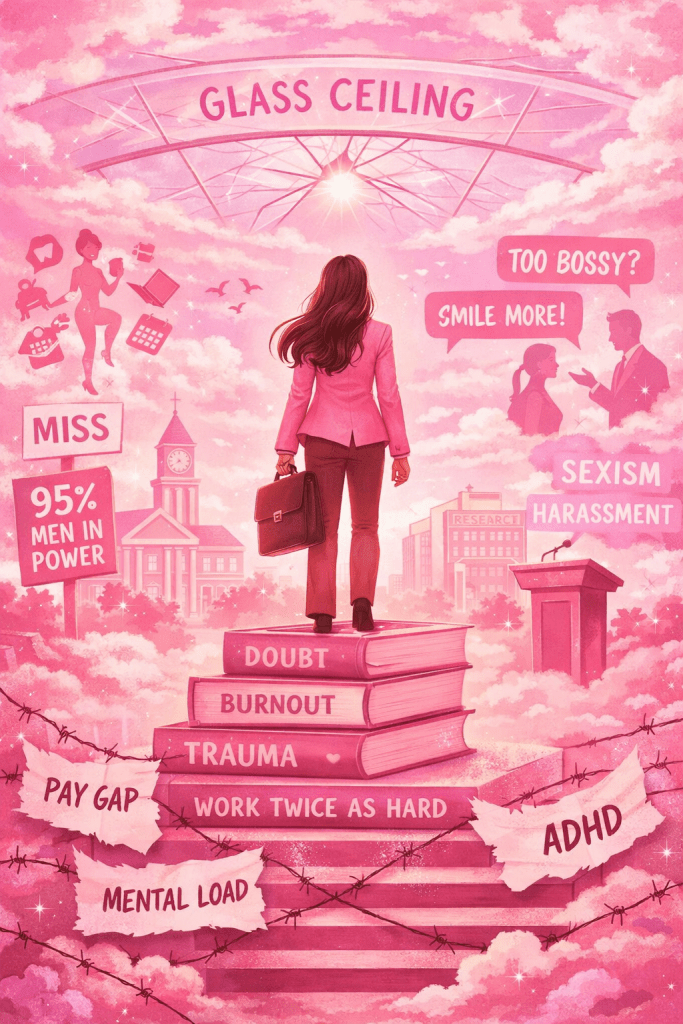
On paper, we have equality.
But equality isn’t the same thing as equity.
And a lot of women know that difference in their bones.
I have a PhD. Statistically speaking, that puts me in a very small minority of the UK population. Around 2% of people here have a doctorate.
Technically I’m more academically qualified than roughly 98% of the country. Crazy I know. I do not feel it at all.
I am a qualified teacher. Have a degree in Chemistry. A masters in forensic and analytical science.
I have spent countless hours reading about the most random subjects imaginable. I can do things that many people would pay someone to do (being from Yorkshire paying for something I can do myself is something I really struggle with).
Yet, despite all this, I still regularly have people (men) explain things to me that I already know. As though I am a 10 year old.
Not in a dramatic way. Not maliciously (most the time). Often they’re trying to be helpful.
But the underlying assumption is there, that I probably need it explaining, because why would I know anything about it.
It’s subtle. But it’s constant.
And to be clear, this isn’t about blaming individual men.
Most of the time people are just operating within the social scripts they’ve grown up with. The issue isn’t “men versus women”.
The issue is the system we’ve all been raised inside.
Because the truth is that women are still expected to work harder to prove competence in the first place.
We are still navigating layers of expectation that our male colleagues rarely have to think about.
I’ve presented at conferences, in my previous career, where comments about my appearance where made before comments about my research.
I have genuinely never seen that happen to a single male in the same industry.
As a teacher in the UK, I get called “Miss”
My male colleagues get called “Sir”
It seems like a small thing, but language carries power. “Sir” implies authority, it implied status. “Miss” feels…softer, younger, less authoritative (personally I would have the kids call me Kate, I do not care for the formality, but why are men put on a pedestal?)
And those little signals add up.
I also see the cultural undertones in classrooms. Students, of all genders, sometimes challenge female authority differently than male authority.
Not because they’re bad kids.
Because they’re absorbing the same cultural messages we all did.
Misogyny rarely looks like outright hostility anymore.
More often it’s background noise.
And while all of this is happening, women are also carrying a huge amount of invisible labour.
The mental load.
Remembering everything. Planning everything. Managing emotional dynamics. Anticipating problems before they happen.
A lot of women are running entire logistical control centres inside their heads.
Now add ADHD into that mix.
ADHD brains are already juggling executive function challenges, organisation, working memory, task initiation, emotional regulation.
When you pile the social expectations of “holding everything together” on top of that?
Burnout becomes almost inevitable.
You’re constantly trying to keep the plates spinning.
Work plates.
Home plates.
Emotional plates.
Invisible organisational plates that nobody even realises you’re holding.
And if you drop one, society is still very quick to label women as disorganised, emotional, or not coping.
So when we talk about women’s success, we often miss the context.
A lot of women are succeeding while running on fumes.
Succeeding while carrying trauma.
Succeeding while managing neurodivergent brains in systems that were never designed for them.
And still being expected to prove their competence over and over again.
This is why the difference between equality and equity matters.
Equality says the door is open.
Equity asks whether everyone had to fight their way down the corridor just to reach it.
So today isn’t really about saying women are amazing.
Most women already know their own strength. They’ve had to.
It’s about recognising the systems we’re still navigating.
And maybe starting to question why so many women are quietly exhausted while still being told that the playing field is already level.
Note: Men also have a day (19th November), before anyone makes that comment.
 Uninspired | Unoriginal | Unhinged
Leave a comment